
 Get Audio+
 Hot FM
 Kool 101
 Eight FM
 Fly FM
 Molek FM

Tengku Hadhira Weaves Nusantara Folklore Into Her Very Own Dark Fantasy Mythos
 Thirsty for JUICE content? Quench your cravings on our Facebook, Instagram, TikTok and WhatsApp
Most artists spend years trying to establish a recognisable creative identity. Dark fantasy concept artist Tengku Hadhira has taken a rather different route.
Rather than settle on a sound or aesthetic, she has been constructing an entire mythology, complete with its own spiritual customs, musical traditions, fictional language, and inhabitants governed by rules of their own.
It’s a world where djinns have their own systems of belief, marriage can involve demons, and repentance comes through rituals of self-sacrifice. Yet beneath its supernatural machinery lies something deeply rooted in the Nusantara, drawing from folklore, spiritual inheritance, and cultural traditions through a distinctly gothic lens.
Hadhira’s fascination with the supernatural began in childhood, shaped by Pan’s Labyrinth, Batu Belah Batu Bertangkup, Pontianak, and the Mr Midnight books. These stories existed alongside her family’s connections to Adat Pepatih and Saka traditions, particularly on her mother’s side in Negeri Sembilan. The latter, she explains, involves a complicated generational inheritance of spiritual practices and the use of spirits to assume and abuse power.
“It’s also a generational tradition passing down to first daughters in the family (I am the first daughter. Unfortunately),” she shares.
Fantasy became a way for Hadhira to process experiences she otherwise struggled to articulate. She recalls feeling “seen and safe” in stories about creation and spiritual illness, particularly those that resonated with her family’s traditions. Over time, her interest in supernatural fiction developed into an attempt to understand the histories and beliefs that had shaped her upbringing.
View this post on Instagram
This informs what she describes as her Nusantara goth aesthetic.
Her research into Mak Yong Main Teri and Silat Berubat has drawn her towards Kelantanese healing practices, particularly the use of music and theatre in exorcism. Rather than treating traditional culture as decoration, she is interested in the spiritual beliefs and histories embedded within these practices, allowing them to inform her compositions, costumes, and performances.
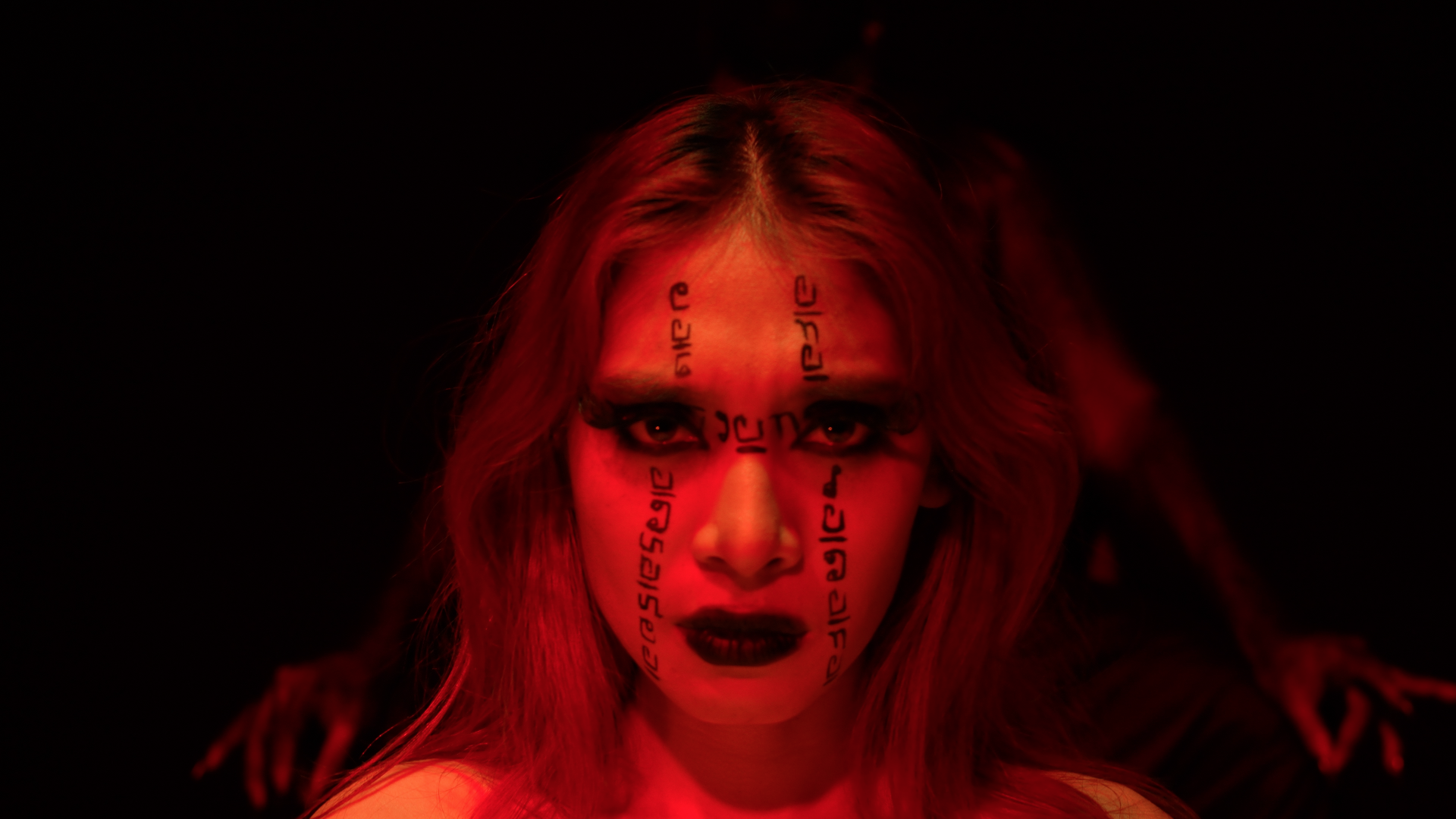
That same attention to cultural specificity extends to language. Bahasa Khorrossit, the constructed language at the centre of her work, began with recurring dreams in which unfamiliar entities and places communicated in tongues she could not recognise. She would try to recall their lettering upon waking, only for much of it to disappear.
“That is why I disliked fantasy stories with English and colonial Anglo Saxon accents,” she explains. “It breaks immersion completely.”
Drawing from Arabic, Javanese, and Bahasa Istana, Hadhira began developing her own vocabulary and pronunciation. She initially wrote her lyrics in English before bringing them to theatre director Asyraf Syahir, better known as Acap, whose background is in linguistics. Acap subsequently translated approximately 99 per cent of the material into Bahasa Khorrossit, helping develop it into a functioning constructed language.
The result became central to Khorrossit, an EP comprising two tracks, ‘Sihir Aman’ and ‘Varashman’, with approximately 90 per cent of their lyrics performed in the fictional language. ‘Varashman’ follows a djinn explaining his cult’s self-sacrificial rituals, confronting the relationship between sin, shame, and the restoration of balance through death. ‘Sihir Aman’ explores similar territory, approaching repentance and death as a means of attaining peace.
Musically, the project draws on the rebab, Cing Kesi Menora, and Serunai Kelantan, alongside classical violins and cello.
View this post on Instagram
Its visual language is equally deliberate, incorporating Hindu and Nusantara influences through batik, sarees, bunga melur, and traditional makeup.
Indian actors Dhakshu, Piravina, and Pera appear in sarees styled with Melayu cucuk sanggul, while Bahasa Khorrossit lettering, designed by Aiman Zulkarnain, is painted onto their faces.
Much of the production was handled independently, from building sets and styling to makeup and sound design. The process was intimate, if occasionally constrained by the realities of independent production. “We’re just a bunch of poor artists trying to make things happen,” Hadhira says.
The personal nature of the project has also made it an exercise in vulnerability. Hadhira admits to questioning her creative decisions almost daily, particularly when presenting ideas to producer Raja Nazrin Shah and Acap. She compares the experience to having someone read her private diary aloud in a classroom through a microphone. It is an understandable anxiety for an artist whose fictional mythology draws so heavily from her own experiences.
Still, its unconventional nature has never been reason enough to abandon it. “We knew this country wouldn’t appreciate our works, but creating peculiar concepts are too much fun to be left in the dusts,” she says.
Hadhira’s ambitions for Khorrossit extend beyond recorded music. She hopes to stage an evening combining live performances and short-film screenings, while developing the story of Saromah, the mythology’s central character: a human woman groomed to marry her demon husband.
Further down the line, she imagines establishing a traditional wooden kampung house dedicated to the study of Nusantara dark arts, spiritual histories, and the broader history of magic, reaching as far back as ancient Mesopotamia. The space would bring together art lecturers and practitioners to teach music and theatre, host experimental performances, and even operate a horror house on weekends. It’ a long-term ambition, perhaps one she hopes to realise by the time she reaches 60.
View this post on Instagram
“I actually envisioned bringing my lore to the grave,” she reveals. “So the stories and narratives would cease with me but immortalised for this country and art practitioners.”
And there’s something poignant about that intention. Hadhira is not simply building a fictional world for audiences to visit and leave behind. She wants to preserve its stories, along with the cultural histories informing them, and leave something that others can study, reinterpret, and carry forward.
Her influences reflect a similar appetite for elaborate world-building. She cites George R.R. Martin, Hiromu Arakawa, and Guillermo del Toro for their ability to construct self-contained universes with their own histories, internal logic, and atmosphere. Mak Yong Main Teri and Javanese mythology are equally important influences, particularly in their theatrical and spiritual dimensions.
Together, these references help explain the ambition behind Khorrossit: not merely an exercise in gothic aesthetics, but an attempt to build a mythology with a life of its own.
Tengku Hadhira is nominated for Person of the Year in JUICE’s Best Of 2026. Voting is open until 7 December 2026. Cast your vote at JUICE’s Best Of 2026.
For more features, click here.
Follow JUICE on Facebook, Instagram, and TikTok.

Missed these?

“Too Much”: Netizens Fear TikTok Trend That Pranks Kids With Kuntilanak Audio Is Traumatising & Extreme
Maybe try the other TikTok trends instead?

Local Actress Bodyshamed By Netizens And Brought To Tears While Filming ‘Live’ Makeup Tutorial
Netizens can be ruthless.

“My Nipples Are Swelling”: Netizens Spam Local Athlete’s Instagram Post With Obscene Comments
He has now deleted the comments…